Changing Yourself: Easier said than done
A few tips for getting (re)started

For the past 5 years, I have been running the Change Management Program at IMD. In every cohort, I ask questions about what people would personally like to change in their lives, and what they believe is holding them back. Across over 400 senior leaders over 5 years, the responses show clear trends. You might recognise yourself among the data:
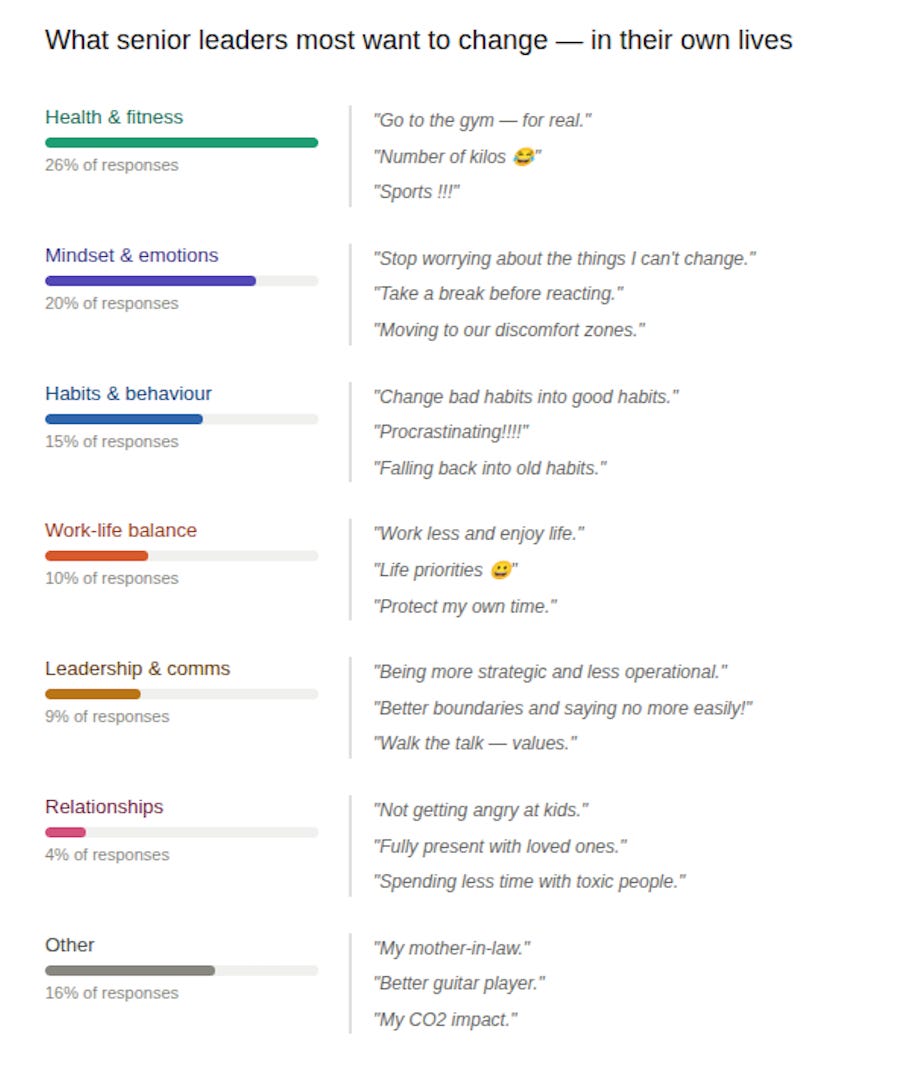
When participants rated how successful their own attempts at personal change had been, the average score was 57 out of 100. Mostly “sometimes yes, sometimes no.” When they rated their attempts to change someone else, that figure dropped to 45. Only one person out of 400 reported 100% success at changing another person. One.
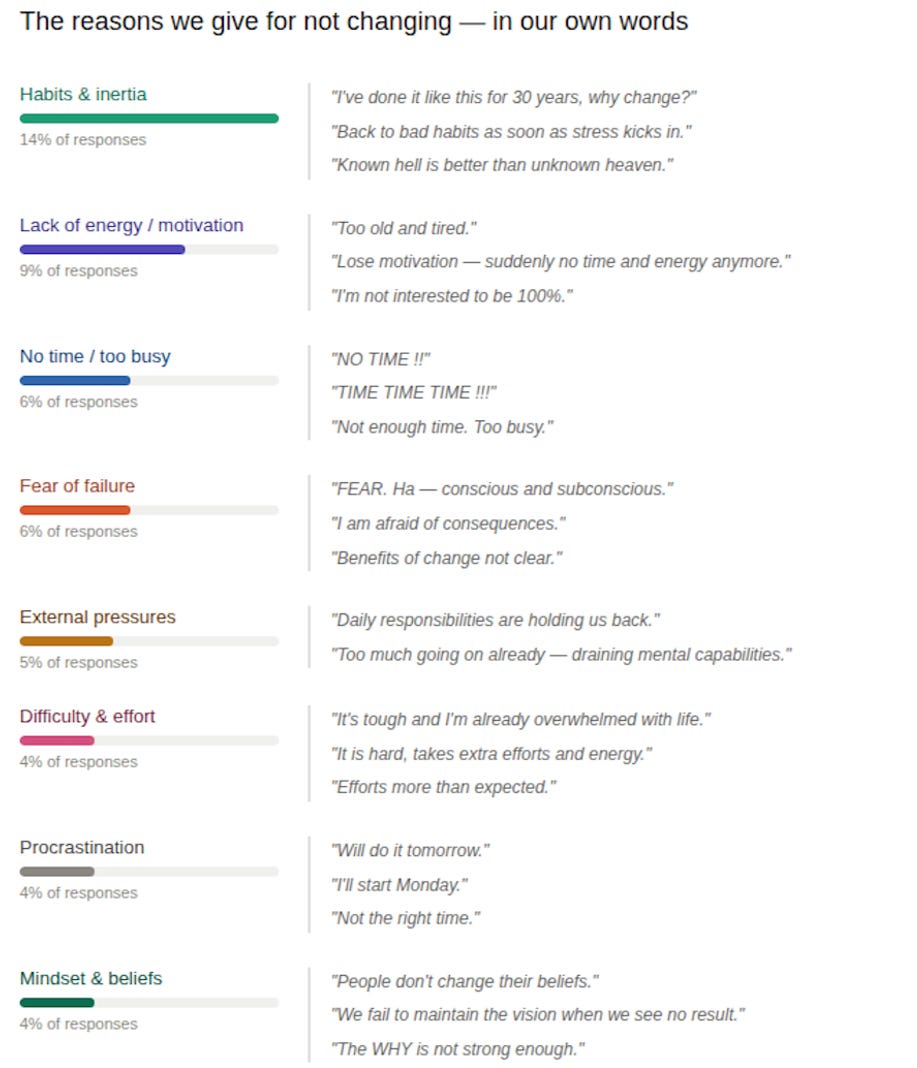
I am reassured by this, as I too have many of the same answers as above - year after year. This means I’m not uniquely “bad at change”, or lacking in willpower in ways that others are not. Nope, I’m just human, bumping up against the same biology and psychology as everyone else.
Given change is - or at least, can be - hard, it warrants a few posts on the topic. So here I am, starting with today’s tips to get (re)started on your personal change journey, when change feels hard.
1. Be honest about your hidden agendas
An uncomfortable question to ask yourself: what do you unconsciosuly want more than the thing you say you want to change? Of course, we all want to be fit, healthy, to set boundaries, to delegate, be present in our relationships. But secretly, is there something under the surface you are committed to more than what you consciously want to change?
We like to think our change goals and our behaviours are aligned. Often they’re not. Harvard psychologists Robert Kegan and Lisa Lahey identified what they call competing commitments — the covert goals that work directly against the ones we announce to ourselves. Their book on the subject describes it as having one foot on the gas and one foot on the brake. You want to go to the gym three times a week. You also want to decompress in the evenings without having to summon more willpower after a long day. Both are real.
If you find yourself repeatedly not following through and confused about what’s happening, it’s worth asking yourself: what am I protecting? What am I not willing to give up? Surfacing and being honest about those hidden commitments won’t automatically dissolve them. But you can’t work with what you can’t access so it’s worth it to do the work.
For those I coach on the topic, blockers often come down to deeply held assumptions and identities. Can’t delegate, though it makes so much sense and you consciously want to? That might be a deep level commitment to feeling important, needed, and in control. It might even threaten an identity you have grown accustomed to (e.g., being ‘the go to’ person). Unconsciously your brain wants to avoid the pain of losing what it clings to.
Being honest about your competing commitments can be very revealing about the real problem you might need to solve.
2. Rejig your context
Our behaviours are shaped far more by our surroundings than we like to admit. Nobel laureate Richard Thaler put it plainly: if you want people to do something, you need to make it easy. The reverse is equally true.
Want to eat better? Put the fruit on the counter and the chocolate at the back of a high shelf. Want to read more? Leave your phone in another room and your book on the pillow. Want to be more present at home after work? Build a physical transition like a short walk, a change of clothes, anything that signals to your brain that the work day is over.

Your social context matters just as much. Hatfield, Cacioppo and Rapson’s research on emotional contagion shows that we automatically and continuously synchronise with the emotional states of those around us — their moods, their energy, their stress. Christakis and Fowler’s large-scale social network studies found that behaviours including smoking cessation, happiness, and exercise spread through social ties in measurable ways. Their findings remain debated (because it’s hard to disentangle social influence from the fact that similar people tend to cluster together, but the basic point holds: the people around you shape what feels normal, possible, valued and worth doing. If everyone around you is stressed, cynical, or disengaged, swimming against that current takes enormous energy.
In sum: spending more time with people who already embody the behaviour you’re trying to build is one of the more practical levers you have. So to my colleague at work (you know who you are) who is an Iron-Man mega athlete, if you find me following you around…you know why.
3. Expect new habits to feel uncomfortable and a little fake at first
When we try to think or act differently, it can feel wrong at first. Awkward, like you’re pretending to be someone you’re not. That feeling is not a sign the change is wrong for you, but it is a sign your brain is working hard. Research by Wendy Wood and colleagues finds that up to 43% of our daily behaviours are “habitual” — running on well-worn neural pathways that took years to build. New behaviours require new pathways, and those only form through repetition. The discomfort is truly part of the process. I find that many people give up because of that initial hard part where it feels painful.

Note that Wood & Rünger’s research also shows that stress actively pushes us back toward habitual behaviour — under pressure the brain defaults to what it knows best. So the moments when change feels hardest are exactly when old habits are most likely to reassert themselves. I’ll be the first to admit that knowing that doesn’t make it easier, but it does make it less mysterious.
Think about learning a language, or a new sport - you wouldn’t expect to feel like a natural in the first few weeks. We tolerate the awkwardness here because we understand it’s temporary.
There are a few practical tips that can help with new habits. James Clear's Atomic Habits suggest a few ideas (and if you rather like listening to or watching podcasts, try this one, or this one).
Make it tiny. The two-minute rule suggests that any new habit should start small enough to take under two minutes — not run three miles, but lace up your running shoes. Showing up consistently matters more than the size of the action.
Stack your habits. Attaching a new behaviour to an existing one borrows the cue of a habit you already have. For example, after you make your coffee, you write for ten minutes. After you brush your teeth, you stretch.
Be specific about when and where. Gollwitzer and Sheeran's meta-analysis of 94 studies found that deciding in advance exactly when and where you will do something (e.g., "I will go to the gym on Monday at 7am" rather than "I will exercise more") had a medium to large positive effect on actually following through. Turning a vague intention into a concrete plan can be helpful in embedding that new habit.
There we have it for today - thanks for reading!
Great post, Alyson! I've struggled with change until I was able to break through in my 40s. I'm glad I never stopped trying! My life changed completely.